Building the Science Together
COLLABORATION AT A GLANCE
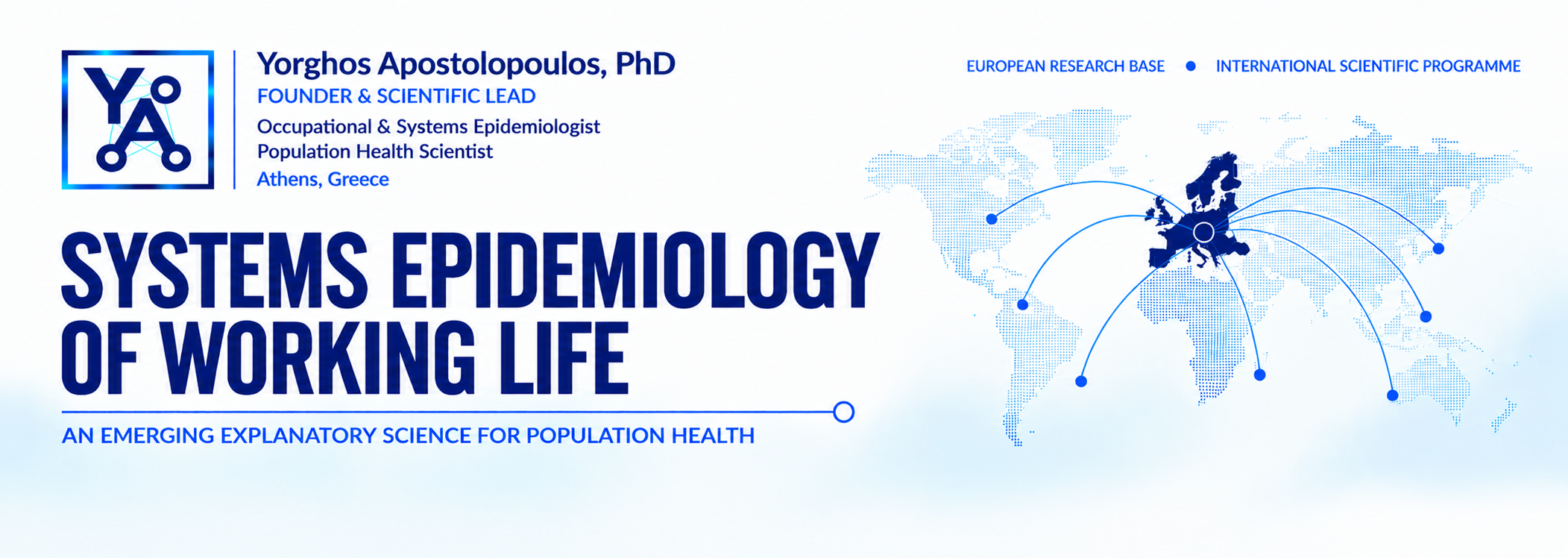
SEWL is being developed through an international and collaborative scientific programme. Its questions span disciplines, populations, institutions, Labour Systems, and countries, requiring complementary expertise, data, methods, and research settings.
Collaboration is particularly valuable for comparative and population-health research, methods and measurement, joint studies and publications, institutional partnerships, collaborative grants and research networks, and scientific exchange. Europe provides an especially valuable setting for comparative research across diverse Labour Systems and institutional contexts, while the programme remains international in scope.
Collaboration is part of the scientific strategy of SEWL. Independent and collaborative investigation across settings and research groups can evaluate generalisability, test competing explanations, strengthen replication, identify limitations, and contribute to the critical evaluation and refinement of the science.
Advancing an International Scientific Community
The scientific questions addressed by SEWL cannot be investigated adequately within a single discipline, population, dataset, institution, or national setting. Developing and evaluating the science requires complementary expertise and institutional perspectives, diverse populations and research settings, and appropriate data resources and methods.
An international scientific community can provide the variation and critical scrutiny needed to compare Labour Systems, investigate propositions across settings, develop and evaluate methods, replicate findings, examine competing explanations, and determine the limits of generalisability.
Researchers, institutions, scientific networks, research infrastructures, and other organisations with relevant expertise or resources are invited to engage through independent investigation, collaborative research, methodological exchange, and critical scientific dialogue.
Research Collaboration
SEWL welcomes research collaborations that bring together complementary scientific questions, expertise, methods, populations, data resources, and institutional perspectives.
Comparative & Population Health Research
Cross-national and cross-system comparisons, longitudinal and lifecourse studies, population cohorts, administrative registers, and linked data resources can provide valuable sources of variation for investigating how Labour Systems and exposure-generating processes generate and pattern Working-Life Exposure Systems and how these systems may contribute to population health, ageing, Human Functioning, and inequalities.
Comparative collaboration is particularly valuable for distinguishing context-specific patterns from relationships that are more consistent across populations, institutions, and Labour-System contexts, while addressing differences in population composition, measurement, institutions, and other sources of contextual variation.
Methods & Measurement
Methodological collaboration can support the development and evaluation of approaches to measuring Labour Systems, exposure-generating processes, Working-Life Exposure Systems, exposure biographies, Human Functioning, and Functional Sustainability. Areas of interest include longitudinal and multilevel methods, causal inference, network and systems approaches, computational methods, data harmonisation and integration, and measurement development and validation.
Collaborative Projects & Publications
Opportunities include joint empirical studies, conceptual and methodological research, comparative analyses, occupational applications, and collaborative publications. Particular value lies in research capable of testing assumptions, comparing alternative explanations, replicating findings, evaluating generalisability, or extending investigations to new populations, occupations, and Labour-System settings.
Grants, Networks & Research Infrastructure
Collaboration may also involve joint grant development, international research networks and consortia, shared research infrastructure, harmonised data resources, and coordinated multicentre or cross-national investigation. These activities can provide the scale, disciplinary breadth, and comparative infrastructure required for questions that cannot be addressed adequately within individual studies or research groups.
Institutional & International Partnerships
Institutional and international partnerships can strengthen SEWL by connecting complementary scientific capabilities, populations, data resources, infrastructures, and comparative settings.
Potential partners include universities and research institutes; occupational- and population-health centres; public-health organisations; research infrastructures and data networks; government and public-sector research agencies; and international scientific networks. Partnerships may support comparative research, data harmonisation and integration, methodological development, collaborative grants, researcher exchanges, shared infrastructure, and international networks or consortia.
The objective is not to create a single centralised SEWL structure, but to foster a distributed international research environment in which complementary institutions and research groups can investigate shared scientific questions across diverse populations, occupational settings, and Labour-System contexts.
Research Opportunities & Capacity Building
As the SEWL Research Programme develops, opportunities may emerge for early-career researchers, doctoral and postdoctoral researchers, and visiting scholars interested in systems-based approaches to working life, population health, exposure systems, ageing, and Human Functioning.
Future opportunities may include research collaboration, visiting researcher arrangements, research exchanges, mentorship, methodological training, and participation in comparative or international projects. Capacity building is conceived as reciprocal: participating researchers can contribute new questions, methods, disciplinary perspectives, access to populations, and critical scrutiny while developing experience in the conceptual, methodological, and empirical investigation of SEWL.
Specific opportunities will be announced as projects, funding, institutional partnerships, supervisory arrangements, and research infrastructure become available.
Scientific Engagement & Exchange
Scientific exchange provides opportunities to examine emerging ideas, challenge assumptions, share evidence and methods, engage with alternative perspectives, and identify new scientific questions and collaborations.
Invitations are welcome for the following forms of scientific engagement:
Keynote and invited lectures
Scientific seminars and research presentations
Research workshops and symposia
Academic and professional conferences
Expert panels and roundtables
Interdisciplinary scientific dialogue
Research and policy discussions
These engagements provide opportunities both to communicate the developing science and to subject its concepts, propositions, methods, and emerging evidence to critical discussion and scrutiny and to engage with alternative perspectives across disciplines and settings.
Connect & Collaborate
Researchers, institutions, and scientific partners interested in the development, investigation, and critical evaluation of SEWL are invited to connect.
Engagement may range from focused scientific exchange around a particular question to longer-term collaboration. This may involve comparative research, methodological development, joint studies and publications, institutional partnerships, grant development, the development and use of data resources, or international research networks.
Collaborations are grounded in complementary expertise, scientific independence, methodological rigour, critical inquiry, and shared scientific questions.
Get in Touch
Email: yorghos@yorghosapostolopoulos.org
ORCID: 0000-0002-8295-5577
Google Scholar: Yorghos Apostolopoulos
LinkedIn: Yorghos Apostolopoulos